
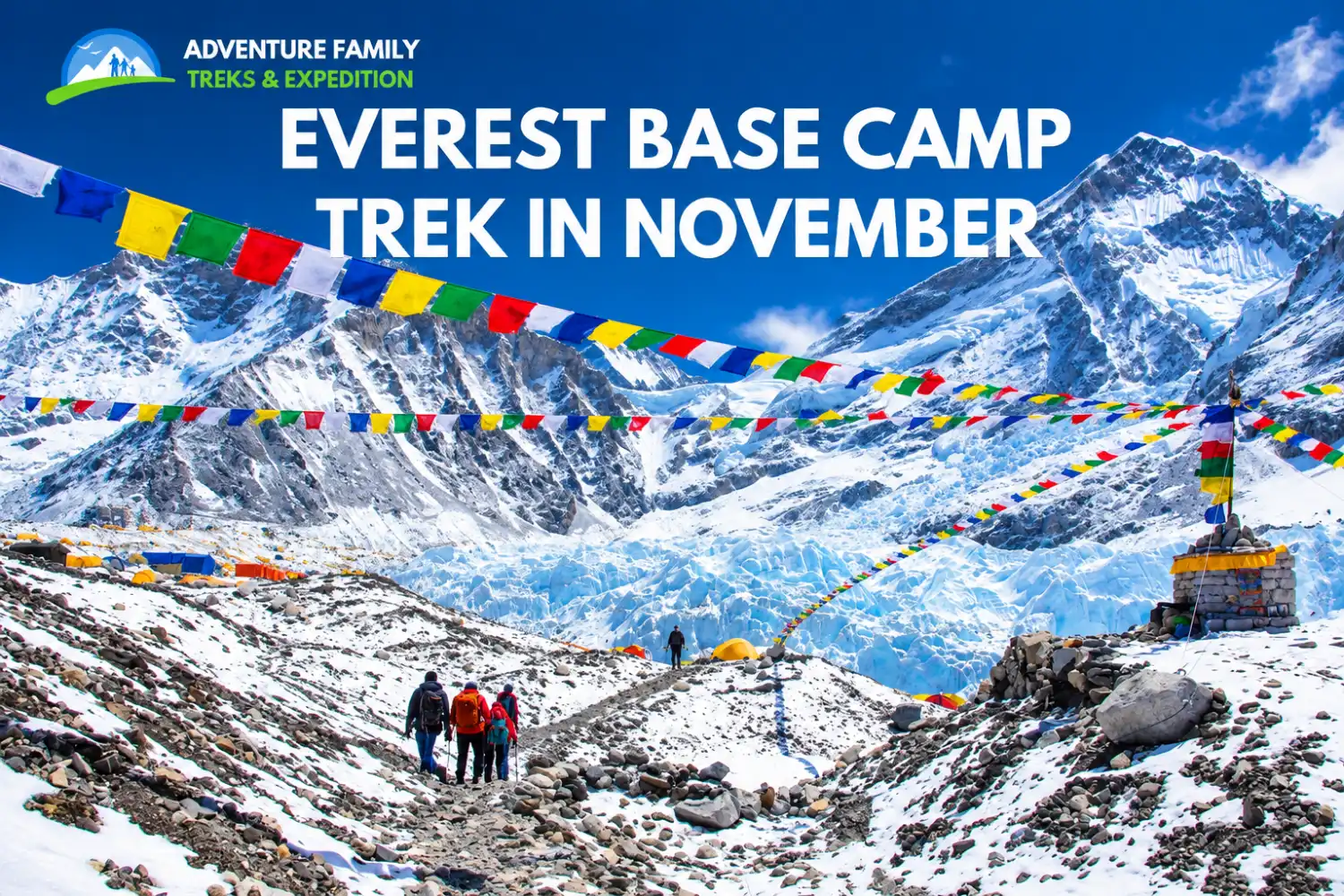
November is the trek that rewards patience. If you missed October's booking window — or simply prefer clear skies without October's crowds — November delivers nearly the same visibility at a noticeably quieter pace and a lower price tag. It's also a significant month for climbers eyeing the region's popular 6000m trekking peaks, since November sits at the tail end of the autumn climbing season for summits like Island Peak, Lobuche East, and Mera Peak.
This guide covers what to expect from an Everest Base Camp trek in November — weather, crowds, costs, and packing — along with why the month matters so much for high-altitude peak climbing in the Khumbu.
By November, the trail has fully dried out and skies remain largely clear, but temperatures drop noticeably compared to October, especially at higher elevations and overnight. Roughly:
| Village | Altitude | Typical Day / Night |
|---|---|---|
| Lukla | 2,860m | 6–10°C / -2–2°C |
| Namche Bazaar | 3,440m | 4–7°C / -7–-3°C |
| Tengboche | 3,867m | 2–5°C / -9–-5°C |
| Dingboche | 4,410m | 0–3°C / -12–-8°C |
| Lobuche | 4,940m | -3–0°C / -16–-12°C |
| Gorak Shep | 5,164m | -5–-2°C / -18–-14°C |
| Kala Patthar (dawn) | 5,545m | -18°C to -22°C |
Temperatures cool progressively through the month, so early November feels considerably milder than late November. At high viewpoints like Kala Patthar, wind chill can push the effective temperature well below what the thermometer shows, making proper cold-weather gear essential.
Visibility in November is comparable to October — the same dry, clear post-monsoon air persists — but with one major advantage: significantly fewer trekkers. Where October's Kala Patthar sunrise can draw large crowds, November mornings are markedly quieter, and lodges that turn trekkers away in peak October weeks generally have rooms to spare.
This makes November an appealing choice for trekkers who want the classic Everest views without jostling for space at viewpoints or worrying about last-minute lodge availability, particularly in the second half of the month.
Early November flight reliability is generally similar to October's strong performance, but conditions become less predictable as the month progresses and Nepal's winter weather pattern starts to establish itself. Morning departures remain the most reliable option throughout the month. As with October, flights during the busier stretches of the season are often routed through Ramechhap's Manthali Airport rather than Kathmandu, so confirm your departure point with your operator. A buffer day or two at each end of your itinerary remains a sensible precaution, particularly if you're trekking in the final week of the month.
Because November sees less demand than October, guided trek costs are typically somewhat lower, and last-minute booking is more realistic — a genuine advantage for trekkers who weren't able to commit to a trip five or six months in advance. Exact pricing varies by operator, season, and inclusions, so confirm current rates directly before booking.
Nepal's festival calendar leans more heavily into October, but November can still catch the tail end of Tihar, the festival of lights, in its first few days. In the Khumbu itself, Mani Rimdu — the significant Sherpa Buddhist festival typically held at Tengboche Monastery — occasionally falls in November rather than October, since its dates shift with the Tibetan lunar calendar. If attending is a priority, confirm the current year's dates with your operator well in advance, since Tengboche lodges fill quickly around the festival.
November calls for a step up from October's gear list, particularly for anything spent at higher elevations:
Hydration also deserves extra attention in November: cold, dry air increases fluid loss even though you may not feel as thirsty as you would in milder weather, so a deliberate drinking schedule matters more than relying on thirst alone.
Beyond the standard trek to Base Camp, November holds particular significance for climbers targeting the Khumbu's popular 6000m trekking peaks — Island Peak (Imja Tse, roughly 6,165–6,189m), Lobuche East (roughly 6,119m), and Mera Peak (the highest of the three, at roughly 6,461–6,476m). These summits are managed as "trekking peaks" by the Nepal Mountaineering Association, requiring an NMA climbing permit rather than a full expedition permit, and are popular introductions to technical high-altitude mountaineering for climbers with solid trekking fitness.
Autumn — running roughly from September through November — is one of the two main climbing seasons for these peaks, alongside spring (March–May). November represents the final weeks of that autumn window before winter conditions make climbing considerably more difficult. Climbers aiming for an autumn ascent of Island Peak, Lobuche East, or Mera Peak often schedule their summit attempt for October or November specifically to take advantage of the stable, largely dry conditions before the season turns.
Because Island Peak and Lobuche East sit within or close to the standard Everest Base Camp trekking route, many climbers combine a Base Camp trek with a peak climb in the same trip. The EBC trek itself doubles as valuable acclimatization: the gradual altitude gain through Namche Bazaar, Dingboche, and Lobuche prepares the body for the additional elevation gain required to summit a nearby 6,000-metre peak, reducing the acclimatization time needed once the climbing phase begins.
Mera Peak, located in the neighboring Hinku Valley, is considered the most approachable of the three technically — it involves no significant technical climbing skills, mainly steady walking on snow and glacier terrain — while Island Peak and Lobuche East require more actual mountaineering technique, including the use of fixed ropes, crampons, and in Island Peak's case, crossing sections with ladder bridges over crevasses.
Even if you're not planning to climb a peak yourself, November on the EBC trail means you may cross paths with climbing groups preparing for or returning from summit attempts on Island Peak or Lobuche East, since both lie directly on or just off the standard route near Chukhung and Lobuche village. It's a reminder that the Khumbu isn't just a trekking destination — it's also a working alpine climbing region, and November is one of its busiest windows for exactly that reason.
If a 6,000-metre summit interests you as an extension of your Base Camp trip, November remains a viable — if increasingly cold — option, though many climbers prefer scheduling peak attempts earlier in the autumn season (September or October) when conditions are marginally milder, saving November purely for the Base Camp trek itself.
Is November a good time to trek Everest Base Camp? Yes. November offers visibility comparable to October, with significantly fewer crowds and generally lower costs, though nights are noticeably colder, particularly at higher elevations.
How cold does it get on the EBC trek in November? Daytime temperatures range from around 6–10°C in the lower villages down to below freezing near Gorak Shep. Nights can drop to -14°C to -18°C at higher elevations, with Kala Patthar dawns reaching -18°C to -22°C.
Is November busier or quieter than October on the EBC trail? Significantly quieter. Crowds thin out noticeably once October ends, particularly at popular viewpoints like Kala Patthar and around lodge availability at Lobuche and Gorak Shep.
Why is November important for 6000m peak climbing in Nepal? November marks the tail end of the autumn climbing season for popular trekking peaks like Island Peak, Lobuche East, and Mera Peak, which are typically climbed in September–November or March–May, before or after the more extreme winter and monsoon conditions.
Can I climb a 6000m peak alongside the EBC trek? Yes. Island Peak and Lobuche East sit on or near the standard EBC route, and many climbers combine a Base Camp trek with a peak climb in one trip, using the trek itself as acclimatization before the technical climbing phase.
Which 6000m peak is best for beginners? Mera Peak is generally considered the most approachable, requiring no significant technical climbing skill, while Island Peak and Lobuche East involve more technical terrain, including fixed ropes and, on Island Peak, crevasse crossings.
Do I need a special permit to climb these peaks? Yes. Island Peak, Lobuche East, and Mera Peak all require a Nepal Mountaineering Association (NMA) trekking peak permit, separate from the standard national park entry permits required for the EBC trek itself.
Is it colder to climb a 6000m peak in November than in October? Generally, yes, since November falls later in the transition toward winter. Many climbers prefer September or October for milder conditions, saving November primarily for the standard Base Camp trek.
