Mountains have always fascinated adventurers, climbers, and travelers. The highest mountains on the world are not just geological wonders—they are symbols of strength, challenge, and natural beauty. From the mighty Himalayas to the rugged Karakoram range, these peaks rise above the clouds and inspire every explorer.
In this guide by Adventure Family Treks & Expedition, we explore the top 15 highest mountains in the world, all above 7,900 meters, including the legendary 8,000-meter giants.
1. Mount Everest (8,848.86 m) — Highest Mountain in the World
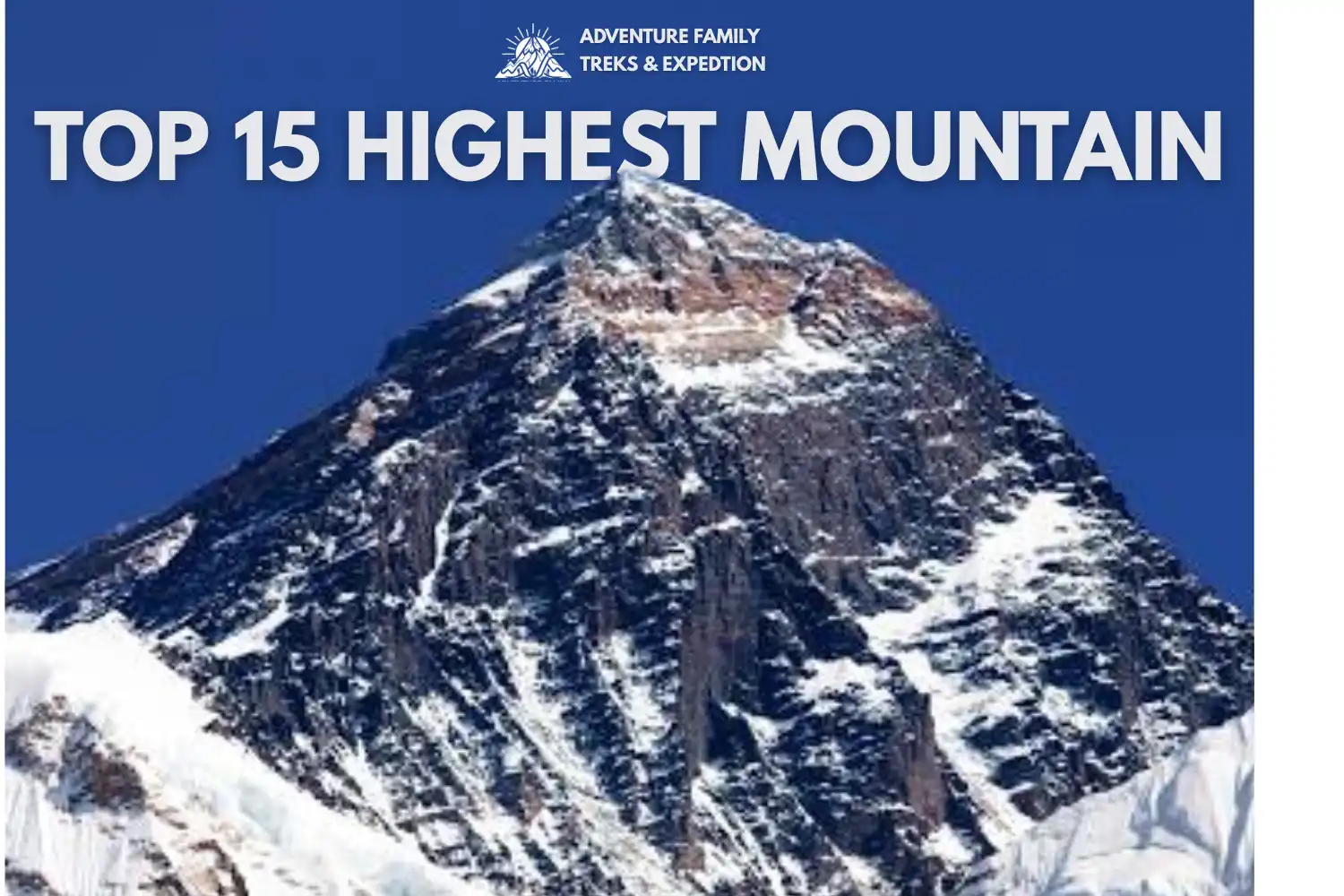
Mount Everest is the highest mountain in the world, located on the Nepal–Tibet border in the Himalayas (Mahalangur section). Locally known as Sagarmatha in Nepal and Chomolungma in Tibet, it means “Goddess of the Sky” or “Mother Goddess of the World.” The first successful ascent was completed in 1953 by Edmund Hillary and Tenzing Norgay. Climbers typically approach from South Base Camp in Nepal or North Base Camp in Tibet. The mountain is fed by major glaciers like the Khumbu Glacier and Rongbuk Glacier. Its extreme altitude creates the “death zone” above 8,000 meters where survival without oxygen support is nearly impossible.
2. K2 (8,611 m) — The Savage Mountain
K2 is the second highest mountain in the world, located in the Karakoram Range on the Pakistan–China border. Unlike Everest, it is far more technical and dangerous due to steep icy slopes and unpredictable weather. The first successful ascent was made in 1954 by an Italian expedition team. Climbers usually begin from the Concordia region near the Baltoro Glacier. The name “K2” comes from a simple survey label rather than a traditional name. Its harsh geography and frequent avalanches have earned it the reputation of being one of the deadliest peaks on Earth.
3. Kangchenjunga (8,586 m) — The Five Treasures of Snow
Kangchenjunga lies on the border between Nepal region in the Eastern Himalayas. It is the third highest mountain in the world and is considered sacred by local communities. The name means “Five Treasures of Snow,” referring to gold, silver, grain, gems, and holy scriptures. The first ascent was achieved in 1955 by Joe Brown and George Band. The mountain is approached via Pangpema (Nepal side) and Yuksom (India side). Due to its remote nature and spiritual importance, it remains less commercialized compared to Everest.
4. Lhotse (8,516 m) — Everest’s Neighbor
Lhotse is directly connected to Mount Everest via the South Col route in the Khumbu region of the Himalayas. It was first climbed in 1956 by a Swiss expedition. Climbers usually use Everest Base Camp as the starting point. The name means “South Peak” in Tibetan. Its most challenging section is the steep Lhotse Face, a massive icy wall that demands technical climbing skills even from experienced mountaineers.
5. Makalu (8,485 m) — The Pyramid Giant
Makalu is located southeast of Everest in the Mahalangur Himal range. It is famous for its sharp pyramid shape and isolated position. The first successful ascent was made in 1955 by a French expedition. Climbers approach via the Makalu Base Camp near the Barun Glacier. The name is believed to come from “Maha-Kala,” meaning “Great Black.” Its steep ridges and exposed routes make it one of the most technically demanding peaks in the world.
6. Cho Oyu (8,188 m) — The Turquoise Goddess
Cho Oyu sits on the Nepal–Tibet border in the Himalayas and is often considered the easiest 8000-meter peak to climb. It was first summited in 1954 by an Austrian team. The base camp is located in the Tingri region of Tibet. The name means “Turquoise Goddess.” Despite being relatively more accessible, its extreme altitude still poses serious risks, and it is commonly used as a training peak for Everest expeditions.
7. Dhaulagiri I (8,167 m) — The White Mountain
Dhaulagiri I is located in western Nepal in the Dhaulagiri Himal range. Its name means “White Mountain,” referring to its massive snow-covered structure. The first successful ascent was completed in 1960 by a Swiss-Austrian-Nepali team. Climbers usually approach via the Italian Base Camp. The mountain rises dramatically from the Kali Gandaki Valley, making it one of the most isolated and visually dominant peaks in the Himalayas.
8. Manaslu (8,163 m) — Mountain of the Spirit
Manaslu is situated in Nepal’s Gorkha region within the Mansiri Himal range. Its name comes from the Sanskrit word “Manasa,” meaning “spirit” or “soul.” The first ascent was achieved in 1956 by a Japanese expedition. Climbers typically start from Samagaon. While the mountain is popular for trekking, its upper sections are highly prone to avalanches, making the summit climb dangerous.
9. Nanga Parbat (8,126 m) — The Killer Mountain
Nanga Parbat is located in Pakistan’s western Himalayas and is one of the most dangerous mountains in the world. Its name means “Naked Mountain.” The first successful ascent was completed in 1953 by Hermann Buhl in a legendary solo push. The base camp near Fairy Meadows offers one of the most scenic views of the mountain. The massive Rupal Face is one of the tallest mountain walls on Earth.
10. Annapurna I (8,091 m) — The Deadly Giant
Annapurna I lies in central Nepal within the Annapurna Himal range. Its name means “Goddess of Harvests.” It holds historical significance as the first 8000-meter peak ever climbed in 1950 by a French expedition. The base camp lies within the Annapurna Sanctuary. Despite its beauty, it is one of the most dangerous mountains due to frequent avalanches and unstable snow conditions.
11. Gasherbrum I (8,080 m) — Hidden Peak
Gasherbrum I is part of the Karakoram Range in Pakistan near K2. Its name means “Beautiful Mountain” in the Balti language. The first ascent was made in 1958 by an American expedition. Climbers access it through the Concordia region and Baltoro Glacier. Its remote location and technical terrain make it one of the least frequently climbed 8000ers.
12. Broad Peak (8,051 m)
Broad Peak is located near K2 in the Karakoram Range. It was first climbed in 1957 by an Austrian team. The mountain gets its name from its unusually long summit ridge. Climbers approach from Concordia. Although slightly less technical than K2, its altitude and harsh weather still make it a serious challenge.
13. Gasherbrum II (8,035 m)
Gasherbrum II lies in the Karakoram Range near Gasherbrum I. It was first successfully climbed in 1956 by an Austrian expedition. The mountain is considered one of the more accessible 8000-meter peaks, but it still demands strong high-altitude endurance. Climbers usually approach via Baltoro Glacier.
14. Shishapangma (8,027 m) — Only 8000m Peak in Tibet
Shishapangma is located entirely within Tibet, making it the only 8000-meter peak fully inside Chinese territory. It was first climbed in 1964 by a Chinese expedition. The name means “Crest above the grassy plains.” Its base camp is located in the Tibetan plateau region. Although considered less technical, it still presents serious altitude risks.
15. Gyachung Kang (7,952 m) — The Hidden Giant
Gyachung Kang lies between Everest and Cho Oyu in the Himalayas. It was first ascended in 1964 by a Japanese expedition. Despite being the lowest among the 8000-meter peaks, it is extremely technical and rarely climbed. Its glaciers connect with the Khumbu region systems, and its remote position makes it one of the least explored major peaks in the world.
Why These Mountains Are So Important
These peaks are not just extreme points on a map—they represent some of the most important natural, cultural, and scientific landmarks on Earth. The world’s highest mountains, especially those in the Himalayas and Karakoram, play a major role in shaping climate systems by influencing monsoon patterns and acting as massive freshwater reservoirs through their glaciers.
For countries like Nepal, India, Pakistan, and China, these mountains are deeply tied to cultural identity and spirituality. Peaks like Kangchenjunga and Manaslu are considered sacred, while others like Mount Everest symbolize global ambition and human endurance.
From an exploration perspective, these mountains have pushed the limits of human survival. Expeditions to peaks like K2 and Annapurna I have led to advances in high-altitude medicine, climbing technology, weather forecasting, and rescue systems. Each ascent contributes to better understanding how the human body reacts in extreme environments.
They also support local economies through trekking and mountaineering tourism. Regions around Lhotse and Cho Oyu, for example, attract thousands of trekkers and climbers every year, creating livelihoods for guides, porters, and local communities.
Final Thoughts
The top 15 highest mountains in the world are more than just elevations measured in meters—they are stories carved into ice, rock, and time. Each peak carries its own identity: some are feared like Nanga Parbat, some are respected for their difficulty like Makalu, and others are admired as stepping stones like Gasherbrum II.
Together, they form the ultimate natural arena where geography, adventure, and human determination meet. For climbers, they are lifelong dreams; for scientists, they are critical ecosystems; and for travelers, they are reminders of how powerful and beautiful the Earth truly is.
Whether it is the highest point on Earth at Mount Everest or the lesser-known but technical challenge of Gyachung Kang, each mountain teaches the same lesson: nature sets the limits, and humans keep trying to understand them.