
Mount Everest: The Mountain That Touches the Sky
28 May 2026
Discover the extraordinary story of Mount Everest — from its formation beneath an ancient ocean millions of years ago to becoming the highest and most iconic mountain on Earth.


Among the countless peaks that rise above Nepal's Himalayan landscape, few mountains capture the imagination quite like Ama Dablam. Often referred to as the "Matterhorn of the East," Ama Dablam is widely regarded as one of the most beautiful mountains in the world. Its elegant pyramid-shaped summit, steep ridges, and dramatic ice formations create an unforgettable silhouette that dominates the skyline of the Everest region.
Standing at 6,812 meters (22,349 feet), Ama Dablam may not be among the world's highest mountains, but its striking appearance makes it one of the most photographed and admired peaks in the Himalayas. Trekkers on the Everest Base Camp Trek often describe their first glimpse of Ama Dablam as one of the most memorable moments of their journey.
Visible from Namche Bazaar, Tengboche, Pangboche, Dingboche, and many other locations throughout the Khumbu Valley, Ama Dablam serves as both a natural landmark and a symbol of the Everest region's extraordinary beauty.
Ama Dablam is located in the Khumbu region of eastern Nepal within the Mahalangur Himal section of the Himalayas. The mountain lies south of Mount Everest and Lhotse and rises above the traditional Sherpa villages of Pangboche and Dingboche.
Its strategic location along the Everest Base Camp trekking route makes it one of the most accessible and visible major peaks in Nepal. Unlike some mountains that are only visible from specific viewpoints, Ama Dablam accompanies trekkers for much of their journey through the Khumbu Valley.
The mountain is situated within Sagarmatha National Park, a UNESCO World Heritage Site known for its spectacular landscapes, rich biodiversity, and vibrant Sherpa culture.
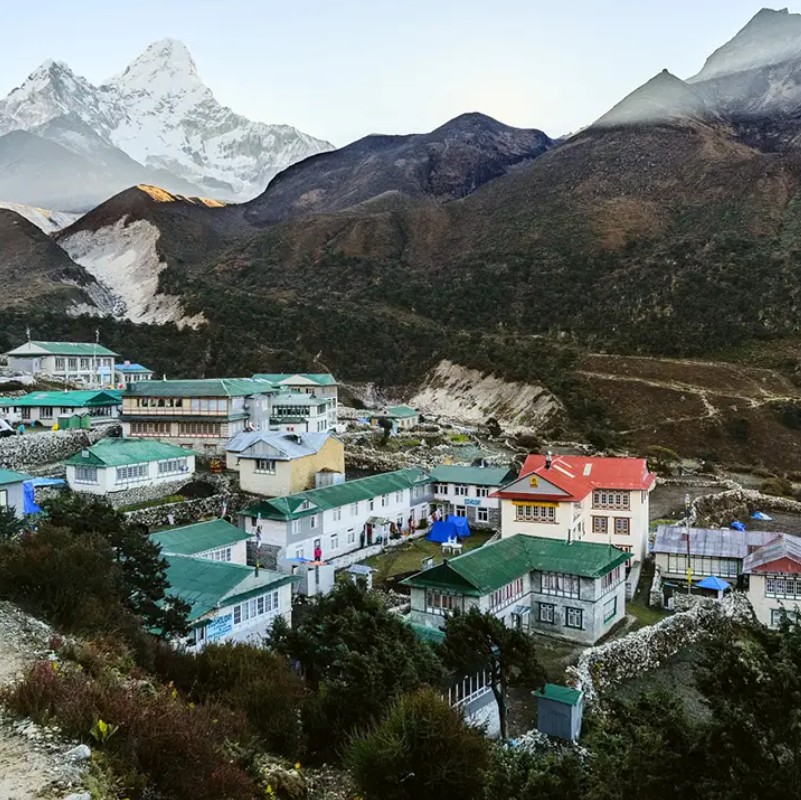
The name Ama Dablam comes from the Sherpa language and carries deep cultural significance.
"Ama" means mother, while "Dablam" refers to the traditional double-pendant necklace worn by Sherpa women. When viewed from a distance, the mountain's long ridges resemble the protective arms of a mother embracing her child. The hanging glacier suspended beneath the summit resembles the sacred pendant traditionally worn around the neck.
This combination gives the mountain its name, often interpreted as "Mother's Necklace."
For local Sherpa communities, Ama Dablam is not only a geographical feature but also a mountain with spiritual and cultural importance.
Ama Dablam is frequently compared to the famous Matterhorn in Switzerland due to its symmetrical pyramid shape and dramatic profile.
Like the Matterhorn, Ama Dablam rises sharply from the surrounding landscape, creating a striking and easily recognizable silhouette. Its steep ridges and elegant summit give it a visual appeal that distinguishes it from many other Himalayan peaks.
The comparison has earned Ama Dablam the nickname "The Matterhorn of the East," a title that reflects both its beauty and its iconic status among mountaineers and photographers.
Many climbers consider Ama Dablam to be even more aesthetically pleasing than the Matterhorn due to its dramatic Himalayan setting and snow-covered slopes.
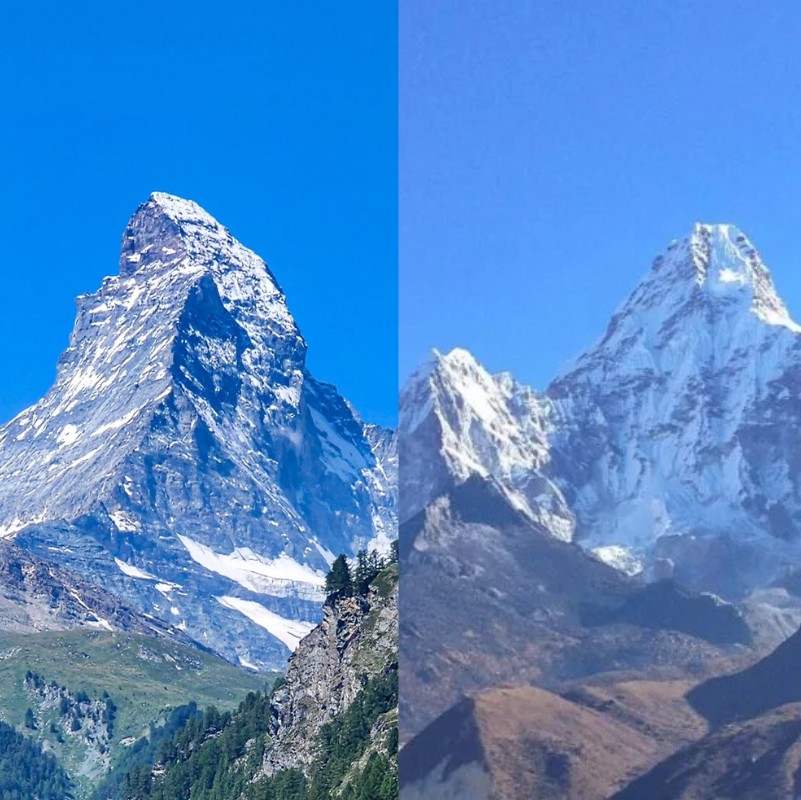
Ama Dablam is known for its remarkably symmetrical structure. The mountain rises gracefully above the surrounding valleys with sharp ridgelines extending from its central summit.
One of its most distinctive features is the hanging glacier located beneath the summit. This glacier forms the "Dablam" portion of the mountain's name and contributes significantly to its unique appearance.
The mountain's steep rock faces, snow-covered ridges, and exposed climbing routes create an impressive combination of beauty and challenge. During sunrise and sunset, changing light conditions transform the mountain into a glowing masterpiece of gold, orange, and white.
Its isolated position within the Khumbu Valley allows Ama Dablam to stand prominently against the sky, making it visible from great distances.
Like the rest of the Himalayas, Ama Dablam was formed through the collision of the Indian and Eurasian tectonic plates. This geological process began millions of years ago and continues today as the Indian plate slowly pushes northward.
The mountain consists primarily of metamorphic and igneous rocks that have been uplifted and shaped by tectonic activity, glaciation, and erosion.
The steep slopes and rugged ridges seen today are the result of countless years of geological transformation. This ongoing process continues to shape the mountain and the surrounding landscape.
Ama Dablam holds a special place in Sherpa culture. The mountain overlooks several traditional Sherpa settlements, including Pangboche, one of the oldest villages in the Khumbu region.
The mountain is often associated with protection, guidance, and spiritual significance. Local residents regard Ama Dablam as an integral part of their cultural landscape and identity.
The nearby Pangboche Monastery, one of the oldest monasteries in the Everest region, offers breathtaking views of Ama Dablam and serves as an important center of Buddhist practice and pilgrimage.
Visitors frequently notice prayer flags fluttering against the backdrop of the mountain, creating scenes that perfectly reflect the spiritual atmosphere of the Himalayas.
Although Ama Dablam attracted attention from early Himalayan explorers, its steep ridges and technical terrain delayed successful summit attempts.
The first successful ascent was achieved in 1961 by a British-New Zealand-American expedition. Climbers Mike Gill, Barry Bishop, Mike Ward, and Wally Romanes reached the summit via the Southwest Ridge, which remains the standard route today.
Since then, Ama Dablam has become one of the most sought-after climbing objectives in the Himalayas. Many climbers consider it one of the finest alpine climbs in the world due to its combination of technical difficulty and spectacular scenery.
Unlike Everest, where many climbers focus on reaching the highest point on Earth, Ama Dablam attracts mountaineers who appreciate the art and challenge of technical climbing.
Ama Dablam is considered one of Nepal's most technically demanding expedition peaks. The mountain requires climbers to navigate exposed ridges, steep rock sections, ice climbing terrain, and challenging weather conditions.
The Southwest Ridge is the most commonly used route. This route follows a spectacular ridgeline that offers breathtaking views of Everest, Lhotse, Makalu, and the surrounding Himalayan giants.
Successful climbers must possess strong mountaineering skills, previous high-altitude experience, and excellent physical conditioning.
Because of its technical nature, Ama Dablam is often described as a climber's mountain rather than a trekking peak.
For most visitors, the best way to experience Ama Dablam is through the Everest Base Camp Trek.
The mountain becomes visible shortly after entering the Khumbu Valley and remains a constant companion throughout much of the trek. As trekkers ascend toward Everest Base Camp, Ama Dablam appears from different angles, each revealing new aspects of its beauty.
Tengboche is widely regarded as one of the finest viewpoints for Ama Dablam. The famous monastery sits on a ridge directly facing the mountain, creating one of the most iconic scenes in Nepal.
Pangboche and Dingboche also offer exceptional views, particularly during sunrise and sunset when the mountain glows with warm alpine light.
Ama Dablam is often considered the most photogenic mountain in Nepal.
Photographers are drawn to its perfect shape, dramatic ridges, and constantly changing colors throughout the day. Sunrise photography is especially popular as the first light of morning illuminates the summit and upper ridges.
The mountain is equally impressive during sunset when golden and pink hues paint the snow-covered slopes.
Popular photography locations include Namche Bazaar, Tengboche, Pangboche, Dingboche, Nangkartshang Peak, and Kala Patthar.
Each viewpoint offers a unique perspective, allowing photographers to capture the mountain's beauty from multiple angles.
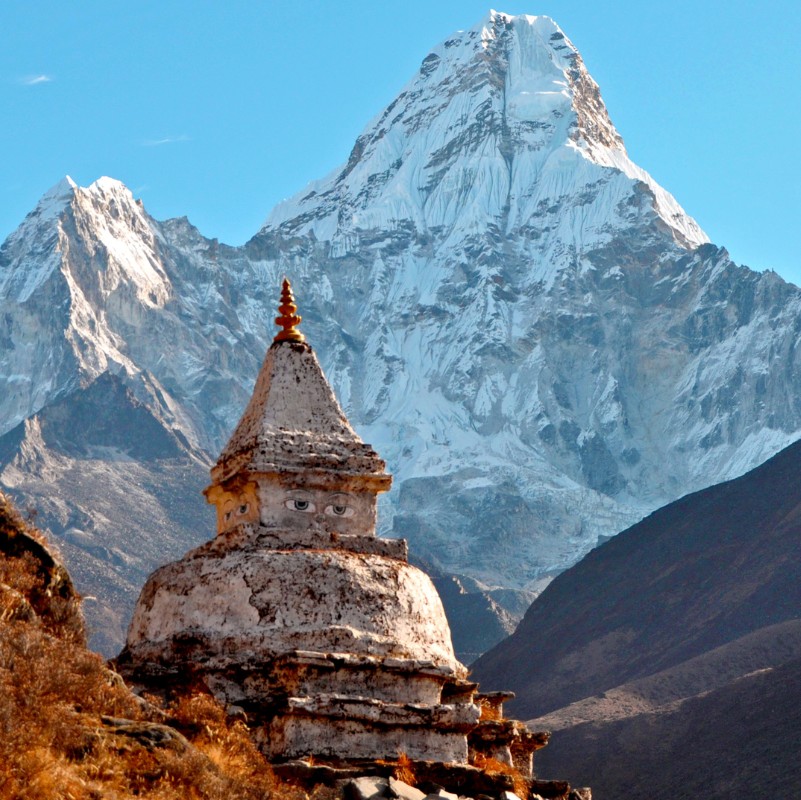
The valleys surrounding Ama Dablam are home to diverse Himalayan wildlife protected within Sagarmatha National Park.
Trekkers may encounter Himalayan tahr grazing on rocky slopes, musk deer moving through alpine forests, and colorful Himalayan monals foraging among shrubs and meadows.
Birdlife is abundant throughout the region, while elusive snow leopards inhabit the higher and more remote areas of the park.
The lower elevations feature forests of rhododendron, pine, fir, and juniper, creating vibrant landscapes during spring.
Spring and autumn are widely considered the best seasons to visit Ama Dablam.
During spring, rhododendron forests bloom across the Khumbu region, adding vibrant colors to the landscape. Clear skies and moderate temperatures provide excellent conditions for trekking and photography.
Autumn offers exceptional mountain visibility, stable weather, and some of the clearest skies of the year. The sharp outline of Ama Dablam against the blue Himalayan sky is particularly striking during this season.
Winter presents beautiful snow-covered scenery but colder temperatures, while the summer monsoon often brings clouds that obscure mountain views.
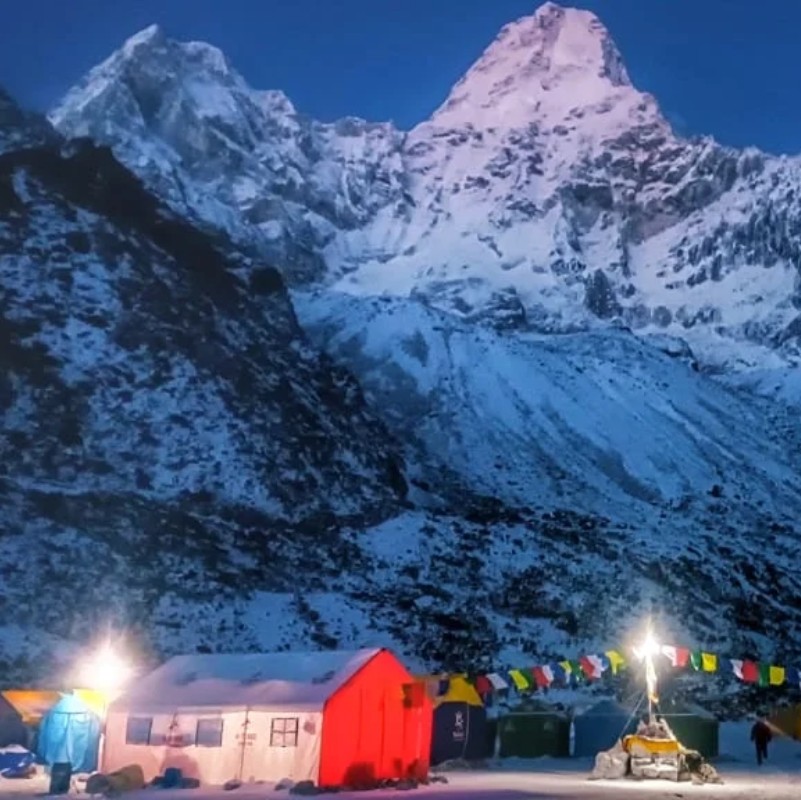
Beauty in mountains is often subjective, yet Ama Dablam consistently appears on lists of the world's most beautiful peaks.
Its symmetrical pyramid shape, dramatic ridges, cultural significance, and stunning location in the heart of the Himalayas combine to create a mountain unlike any other.
Unlike many famous peaks that require significant effort to view, Ama Dablam rewards trekkers with unforgettable vistas throughout the Everest region. Whether seen from a monastery, a mountain trail, or a high-altitude viewpoint, it leaves a lasting impression on all who witness it.
Ama Dablam is far more than a mountain. It is a symbol of the Everest region's natural beauty, cultural heritage, and mountaineering history. Known as the Matterhorn of the East, its elegant profile has inspired generations of trekkers, climbers, photographers, and adventurers.
Whether you are trekking to Everest Base Camp, exploring Sherpa villages, or pursuing a Himalayan climbing expedition, Ama Dablam will undoubtedly become one of the highlights of your journey. Its beauty, presence, and timeless appeal ensure that it remains one of Nepal's most treasured mountains and one of the most iconic peaks on Earth.

Discover the extraordinary story of Mount Everest — from its formation beneath an ancient ocean millions of years ago to becoming the highest and most iconic mountain on Earth.

Mount Pumori is one of the most beautiful mountains in Nepal's Everest region. Standing at 7,161 meters, this iconic Himalayan peak is known as the "Daughter of Everest" and offers breathtaking views from Everest Base Camp and Kala Patthar. Explore its history, climbing challenges, trekking highlights, and the best time to visit.

Nuptse is one of the most spectacular mountains in Nepal's Everest region. Standing at 7,861 meters, this massive Himalayan peak dominates the skyline around Everest Base Camp and Kala Patthar. Explore its history, geography, climbing significance, and breathtaking views.
